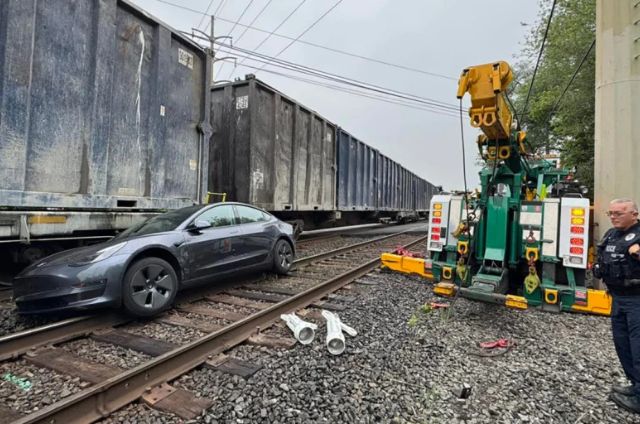
A Dangerous Near-Miss on Active Tracks
A Texas driver says his Tesla on Tesla “Full Self-Driving” (FSD) unexpectedly accelerated through a lowered railroad crossing just seconds before a train passed through the intersection.
The driver, Joshua Brown, claims he was fully stopped at an active crossing with lights flashing and barriers down when the vehicle suddenly moved forward on its own.
Driver Forced to React Instantly
Brown says the car advanced without warning, forcing him to react in a split second. As the Tesla crossed the tracks, the barrier arm was struck and thrown toward the vehicle.
He then pressed the accelerator to clear the rails before the approaching train arrived, narrowly avoiding a collision.
He described the moment as shocking and said it was the first time FSD had ever failed him in this way.
Pattern of Railroad Crossing Failures
This incident is not isolated. Other reported cases have shown Tesla vehicles on FSD ignoring or failing to properly respond to railroad barriers, including videos of cars entering crossings with arms down.
U.S. regulators, including NHTSA, are already investigating multiple FSD-related incidents involving traffic violations and safety concerns.
The agency has linked the system to dozens of crashes and dozens of injuries across different scenarios, including intersections and rail crossings.
Rising Pressure on Tesla’s FSD System
Tesla has continued to roll out updates to FSD, but the system remains classified as Level 2 driver assistance, meaning the driver is still responsible for monitoring the road at all times.
The company has also promoted improvements in newer software versions, but incidents like this keep raising questions about how reliably the system handles rare or high-risk situations like railroad crossings.
Why This Matters
Railroad barriers are designed as clear, physical stop signals that should be easily detected even by distracted drivers. Failures in these situations are especially serious because trains cannot stop quickly.
The incident adds more pressure on Tesla’s autonomous driving ambitions as regulators and drivers continue to question whether current systems are ready for real-world edge cases.